
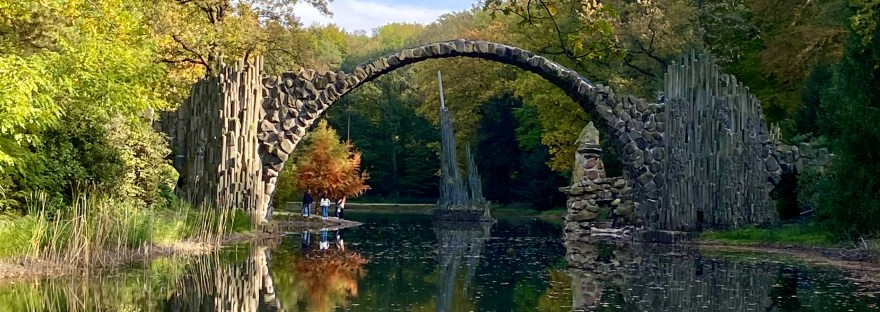
I am of the strong opinion that whosoever claims the Rakotzbrücke, also known as the devils’ bridge, to be an overhyped tourist attracted is either lying or was simply unlucky with the weather. In the worst possible scenario, they were met with some construction work, in which case, I can sympathize and understand their frustration. I, on the other hand, was enamored by its beauty, simplicity and unique architectural design that forms a perfect circle over Rakotzsee, a serene and tranquil lake in the middle of nowhere in Gablenz, Saxony.

It must have been around five years ago when I laid eyes on the devil’s bridge for the first time. The elegant structure of this artificially carved arching bridge looked straight out of a Grim’s brothers fairy tale. Its archaic form, cobbled columns and medieval look comes from basaltic rocks that were shipped from distant quarries by its commissioner, Friedrich Herrmann Rötschke. The Devil’s Bridge serves no practical purpose, as one can walk around the entire lake in less than 15 minutes. It was never intended to be used. It is art for art’s sake.

The name “Devil’s Bridge” is rooted in local legend, which speaks of a villager who struck a deal with the devil to build this complex structure. In return for his help, the devil demanded the soul of the first living being to cross the finished bridge. However, the cunning villager outsmarted the devil by sending a goat to be the first to cross the bridge. Poor goat!


Given its offbeat location in East Germany, the Rakotzbrücke is not a usual destination for tourists and travelers. My fiancé and I made the three hours’ drive from Prague to Weißwasser, the closest town to the bridge, where we also stayed overnight. Since we were already in the area, it was my suggestion to explore the autumnal foliage and a few other places of interest this area has to offer. In the end, we combined our visit to Rakotzbrücke with a few other neighboring towns and cities.

Our first destination was Bad Muskau, a small spa town in the state of Saxony with Poland on its eastern border. Being a resident of Prague, which is in the historical region of Bohemia, I found it interesting that this town was once a part of the larger kingdom of Bohemia up until 1635. Today, the Muskau castle, a well-preserved UNESCO site with its brick red walls and large open grounds, is an important landmark of Germany and Poland.

After spending an hour or so in Bad Muskau, we made our way to Görlitz, arriving in the city around 2:30 PM on a Saturday. To our disappointment, we soon discovered that all the exhibits close from 2:00 PM and the restaurants don’t reopen until around 5:30 PM. Thankfully, the Schlesisches museum was open, and we were able to absorb the local history and culture of the region. We crossed the bridge from Görlitz to Zgorzelec in Poland and ended our visit with an overpriced ice cream.

On Sunday, before heading back to Prague, we decided to make a final stop to Bautzen, a Sorbian minority town in East Germany. What we didn’t know at the time was just how picturesque and charming the little town of Bautzen truly is. It reminded me of the old castles and kingdoms in the illustrated storybooks that I used to devour as a child. Undisturbed by war, the general vibe of this pretty town is cozy, comforting, and, dare I say, very romantic.

Bautzen is not very Germanic in nature and people here are ethnically Slavic. The Sorbian language is gradually dying with only 60,000 speakers as of today. Constant efforts are being made on a national and regional level to preserve the culture, traditions and language of the Sorbs. Easter is a special celebration, and this region upholds the age-old tradition of decorating Easter eggs with wax and other sophisticated methods.

Due to the demands of my strenuous job in the tech industry and the ongoing news of family illnesses, I haven’t been able to travel as much as I would have liked this year. This short and well-executed trip was a much-needed distraction, and I’m glad I made it happen.


© Copyright: Leah Chrestien. October 2024. The post Saxony’s Secret: The Devil’s Bridge and medieval towns first appeared on The Ecstatic Storyteller. The author reserves the right to the content and the pictures. No reproduction of content or picture in any form is permitted without the prior consent of the author.

 theecstaticstoryteller.blog
The photos here are absolutely beautiful 😊
LikeLiked by 1 person
Thank you, Laura. The bridge, to me, is really beautiful at this time of the year.
LikeLiked by 1 person
Thank you, Leah, for sharing and for the lovely photos. The bridge looks magical and the town of Bautzen looks wonderful. Keep well. 🙏
LikeLiked by 1 person
Thank you, Ashley, for your kind words and for reading. 🙂 Take care.
LikeLiked by 1 person
I’ve seen that bridge in photo’s before – I really want to visit it.
LikeLiked by 1 person
I hope you get a chance to visit it. It is beautiful in all seasons. Thank you for reading.
LikeLiked by 1 person
It looks so beautiful – You’re welcome 🙂
LikeLiked by 1 person
Sounds like my kind of place to visit if I didn’t have quite so many cats and kids 🙂
Those pictures are fantastic.
LikeLiked by 1 person
I hope you get a chance to visit at least once in your lifetime. As for the pictures, they do not do proper justice to the actual scenery and the many sounds of the surrounding woodlands.
LikeLiked by 1 person
We’ll see. I sure hope to visit the area. 🙂
LikeLiked by 1 person
“The Devil’s Bridge,” viewed from a distance with its reflection, looks like a portal to another dimension.
LikeLiked by 1 person
This was my exact thought when I saw the pictures for the first time. Thank you for reading. 🙂
LikeLiked by 1 person
🙂
LikeLiked by 1 person
ice cream on a beautiful bridge in autumn, I could do that!
LikeLiked by 1 person
It does sound like a fun activity for a bright autumn afternoon. 🙂 Thank you for reading.
LikeLiked by 1 person
A really informative write packed with information and nice photographs too.
LikeLiked by 1 person
Thank you, David. Nature is wonderful at this time of the year.
LikeLike
What a beautiful structure, Leah, and wonderfully described. Thank you.
LikeLiked by 1 person
Thank you, Michael, for your kind words.
LikeLiked by 1 person
Thank you for the beautiful photo stroll. Lovely post, Leah.
LikeLiked by 1 person
Thank you, Michele, for your kind words 🙂
LikeLiked by 1 person
You’re very welcome, Leah and thank you for sharing your descriptive writing, along with your beautiful photos. 🌻
LikeLiked by 1 person
Fabulous captures. The Devil’s Bridge looks beautiful.
LikeLiked by 1 person
Thank you so much for reading 🙂
LikeLiked by 1 person
fascinating; count me a subscriber —
LikeLiked by 1 person
Thank you, John. I hope you get to visit it someday. 🙂
LikeLiked by 1 person