“Beauty is the only thing that time cannot harm. Philosophies fall away like sand, creeds follow one another, but what is beautiful is a joy for all seasons, a possession for all eternity.” – Oscar Wilde
Dear Readers,
Before diving into the depths of this opinion piece of mine, it is important to make you acquainted with my professional background. While going through the contents of my blog, it becomes increasingly clear that I have a strong affinity towards English literature. While my love for language (both in the Bengali and English) goes back to my childhood, my professional career has always been in the sciences. I have a bachelors degree in Physics from St. Stephen’s College, Delhi and a masters in Advanced Computing from King’s College London. At the time of writing this article, I am employed as a doctoral student in the Czech Technical University. To keep it brief, I work in the domain of knowledge discovery which involves improving and evaluating the heuristic function in search algorithms. For those unfamiliar with the aforementioned terms, I train neural networks (I’m sure you’ve come across this ultra popular term !) that ‘quickly’ and `optimally’ generate solutions to given problem(s). I publish scientific papers, some of which have received citations from fellow researchers; I deliver scientific and mathematical talks on my research in Artificial Intelligence (AI) conferences and my papers are listed on Web of Science and Scopus. In short, I am an AI scientist by profession.
Motivation for this opinion piece:
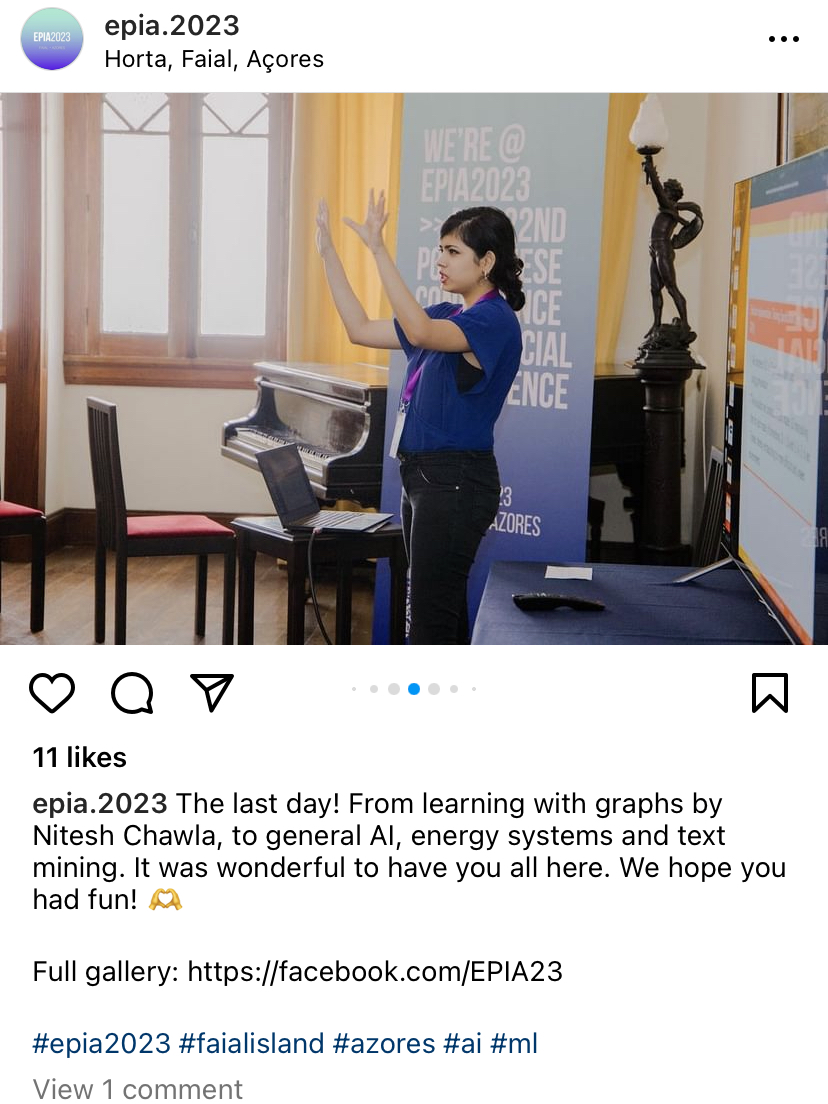
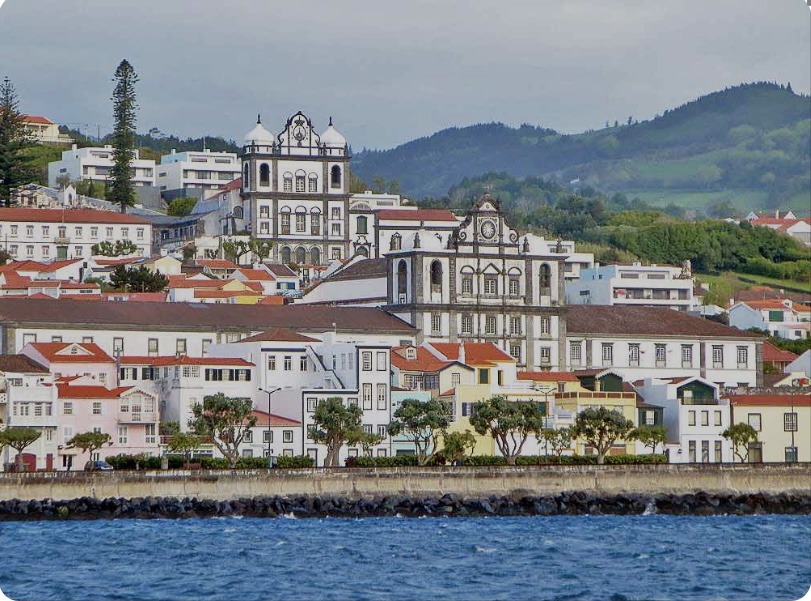
Recently, I was fortunate enough to attend and present my research findings at the 22nd Portuguese Artificial Intelligence conference (EPIA 2023) which took place in Horta, Faial island, Azores. I met a lot of wonderful people and attended many appealing and insightful talks.
While there were some interesting talks on recent developments, one in particular, stood out to me. It was titled Erato: Automatizing Poetry Evaluation. The first author of the paper was a nice affable gentleman who developed an AI system named Erato1 that evaluates AI generated poetry (created by ChatGPT) based on parameters such as metrics, novelty, redundancy etc. My first reaction was skeptical and I started to wonder if the creation of an evaluation system was necessary, given that artistic tastes (for the greater part) are highly subjective. Funnily enough, I was reminded of a scene from the movie Dead Poets’ Society where Robin Williams asks his students to rip off those pages of a book that attempted to put scientific constraints on poetry. Of course, an automated system in place, capable of checking rhyme and meter among other parameters that are consistent with the rules of a language, can be useful for those who require a second opinion on the more technical aspects of their writing. But to decide upon what is novel and redundant is a much more difficult task and a near impossible question to answer (I briefly touch on this later). In fact, I am of the opinion that there is no convincing metric in place that can evaluate whether a literary work is novel or redundant (besides those that have obvious similarities).
A philosophical talk at the conference:
It is no secret that core scientific conferences avoid philosophy (excluding those from AI Ethics and Security) at all costs. The conflict between science and philosophy started a while back and has been well documented in recent history. Back in the days, Stephen Hawking’s infamous statement ‘Philosophy is dead’ caused quite a stir among philosophers. Today, scientists take one of two sides: either, they consider the paths of science and philosophy to have diverged a while back, thereby making philosophy irrelevant to scientific progress; or, they are indifferent to what the philosophers from non-AI backgrounds have to stay as their opinions do not have any real time implications in their day to day life. The latter, simply work on projects that bring in the funding, which, in turn, can further their research, motivate them to publish papers and fund their travel to exotic places where they can present their findings. The time allotted to philosophical debates is, often, restricted to a drunken evening.
The round table talks by AI scientists in industry/university are much more pragmatic and grounded in reality. It is a little trickier for those working in AI Ethics; however, for the most part, they too, have a background in hard core mathematical sciences (and law). Here are some of the most popular topics of discussion in a regular AI meeting – Where to get training data? How to select relevant data? How to automate the generation of ‘important’ datasets ? What AI projects is the government currently funding? How to generate toy problems that emulate the larger problem? How to compete against tech giants using limited computational resources? How to write good papers tailored to a particular conference? It is very important to state that most of us Do NOT spend much time discussing overtly popular topics such as these – Will robots enslave humans? Will AI take over the world? Can machines gain consciousness ? Etc. Etc.
While there are dedicated spaces and platforms for these convoluted topics, most of us do not get paid for these discussions. In general, there is a disconnect between AI researchers working at the ground level and AI Philosophers (ex-scientists and CEOs) giving interviews on Youtube and podcasts. The heated discussions on larger-than-life topics make it seem as if most of us are developing terminators, which, I assure you, is far from the truth.
Computer Scientists, in my opinion, are a bit more accepting of philosophy as compared to physicists and researchers from other core scientific disciplines. It was interesting to see a completely non-scientific and more philosophy oriented paper titled ‘A Path to Generative Artificial Selves’2 presented at the conference by a doctoral student pursuing Philosophy. Needless, to say, the young lady’s paper received mixed reactions from AI scientists.
Personally, I do not dislike philosophy. Frankly, as I was reading Mary Shelly’s Frankenstein many years back, I was shocked at how ahead of its times the book is! Considering, she was only 18 when she wrote that book, I think it is a phenomenal achievement on her part. In fact, I think that all AI scientists should read that book.
I do not have a university degree in Philosophy. Therefore, most of my opinions are derived from personal encounters with students of philosophy or from blogs which are sent to me by proponents of philosophy. Often, when I read these philosophy based AI articles, it becomes crystal clear to me that the writer has never worked with artificial intelligence and is definitely not someone with a scientific background. He/She comes across certain scientific concept(s) from a popular science article or an easy-to-understand science blog and tries to fit them within the framework of already existing texts on philosophy, which, at often times, leads to misleading motivations and even worse conclusions.
In the young lady’s paper, she justifies (from a philosophical point of view) why AI is not creative. To most people coming from a humanities background, the statement is obvious and true. From the point of view of an AI scientist or scientists in general, the answer is not obvious at all. I do not speak for all AI scientists but the following paragraph states my opinion which I will try to keep as short and simple as possible.
Our knowledge of the human brain is limited. From the time of birth, our brain processes the environment and learns from new experiences and memory. In some ways, this is exactly what the neural networks are trained to do, albeit, on a much smaller scale. Even to this day, we do not know what neurological processes and electric impulses are at play when the human brain composes the 9th symphony or paints the Mona Lisa! All we know is, there has to be some sort of training, experience replay/priors and exploration involved, each and every time an artist creates a work of art. If we were to draw parallels, AI models, too, learn information from large databases, which they later use to create new art/music/literature. As expected, some of the AI generated results are better than the others. Today, generative AI models are able to successfully generate artistic images that are aesthetically pleasing. There are instances when AI has produced symphony music3 and written a play4, both of which were performed on stage. Therefore, I would disagree with those that claim AI is not creative. AI lacks consciousness and responds to human queries; however, it is still creative in a literal sense of the word.
A little more on AI’s creative abilities:
A lot of people from diverse backgrounds are under the impression that AI was created to replace humans. This goes into the realms of AI philosophy and since we are nowhere near that stage, I will not talk about it in this post. The way I see it, AI development is, instead, focused on recreating humans activities.
Sometimes, it is important to remind ourselves that AI is not living and breathing; it has had no childhood and has never undergone any personal struggle. Therefore, the parameters that are normally used to make assumptions and conclusions on a conscious system (human) cannot be directly applied to an unconscious system (AI). In my opinion, this is a mistake that philosophers often make.
Most of the AI softwares we use, are decentralized (I am not talking of recommended systems in this context). This means, they do not know you or me personally. Thus, in order to get a satisfactory outcome, we need to precisely and accurately state what it is that we expect from AI. If we want AI to create a personalized poem for ourselves, we need to feed it with intricate details. The more details you provide, the more personalized it will be. Have patience – change the language of your queries – add constraints if necessary – you might actually get a poem that is both personalized and creative. The end result is, the AI has recreated a conventionally human task. Essentially, we do not care how it has done it ( we cannot explain scientifically and beyond a reasonable doubt how humans do it, can we? ); we only care about the quality of the poem.
ChatGPT 3.5 and Poetry:
Let us look at the 2 poems written below. One of them is generated by ChatGPT and the other was composed by a human poet. Before scrolling down to read the rest of the article, can you identify which one is which ?
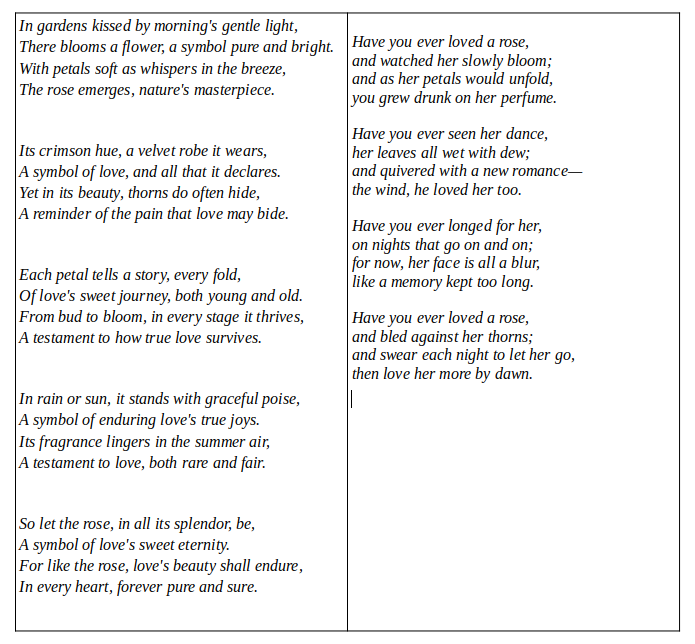
In case you haven’t figured out, the one on the left is generated by ChatGPT and the one on the right is written by Lang Leav. The two poems talk of a rose flower. I asked ChatGPT to write a poem on a rose. I am not here to justify why one poem is better than the other – I’ll leave that up to the reader. I will, however, point out some of the features of the AI generated poem – specifically, the ones I look for, in order to make distinctions between a machine generated poem and a poem written by a human from scratch.
The poem is impersonal. Looking at the first poem, there is no use of pronouns such as ‘I’ , ‘You’ etc. It is worded in a way that speaks more about the attributes of a rose and less about how a rose flower makes one feel. Unless explicitly queried, ChatGPT will always generate very generic poems on roses , which is not necessarily a bad thing.
The poems will mostly be positive . As humans, we tend to associate a rose with happy and positive thoughts and feelings. This reflects in the first poem. In contrast, the second one invokes mixed emotions from the readers; the poet beautifully blends a few favorable attributes of a rose with her own melancholic reflections – she doesn’t solely focus on the aesthetics of the flower. If you repeatedly ask ChatGPT to write poems on roses, it will generate poems that are similar to one another.
Overfitted on Classical Literature. As expected, ChatGPT was trained on a plethora of classical literature; therefore, the poems generated will be rhyming in nature, and oftentimes, contain archaic words and an antiquated sentence structure. As an experiment, try asking ChatGPT to write a free verse poem on a rose. It will be unsuccessful. You might have a better luck with free verse poetry if you feed ChatGPT the first few lines of a poem and ask it to finish the rest of it. In my experience, it always tends to produce rhyming poetry.
aa-bb rhymes: The AI generated poems on a rose will mostly consist of 4 lines in each stanza with the aa-bb rhyming scheme. As an experiment, I asked ChatGPT to write a poem on a rose with the ab-ab rhyming scheme – it failed to generate a poem following this constraint. Again, one might have better luck with feeding ChatGPT the first few lines of an ab-ab poem (see the hybrid poem written below). Interestingly, when I asked ChatGPT to write a non-rhyming poem on a rose, it then produced a poem with the ab-ab rhyming scheme in some stanzas and aa-bb in others!
ChatGPT produces better results when asked to complete a poem: I am of the opinion that ChatGPT generates better poems when the first few lines are fed into it. In the poem below, I have written the first 8 lines; ChatGPT writes the next 12 lines. You can share your thoughts on this hybrid poem in the comments below.
With fondness, I caress the smooth velvety finish;
On its beauty, I have composed praises in prose;
I watch as the soft white petals unfurl on my touch,
Unparalleled in charm is the wonder that is a Rose.

Many centuries old paradigm of love ‘n’ affection,
I will inhale its sweet scent when the wind blows;
While the delicate petals still bloom in my hand,
I will rejoice in the perfect symmetry of my Rose.

In gardens of memory, it forever shall reside,
A symbol of passion, in its essence, it glows.
In the language of flowers, its message is clear,
A timeless emblem of love, my cherished Rose.

Its thorns may hide amidst the tender grace,
A reminder that love can sometimes impose,
Yet I embrace them too, for in their embrace,
I find the strength within my precious Rose.

Through seasons of change, it stands resilient,
In storms and sunshine, it gracefully knows
That love, like this flower, will endure and thrive,
A testament to the enduring spirit of the Rose.
While I certainly enjoy reading poems generated by ChatGPT, both for pleasure and research purposes, it is very evident that there are significant issues with ChatGPT’s machine generated poetry. Even then, if it were up to me, I would advice young poets to personalize their poems, especially when they submit their work to competitions. This means, unfortunately, that the poet might have to make certain adjustments to change his/her writing style in order to set himself/herself apart from AI generated poetry. While this, to me, is unfair, it increases the chances of getting their poems accepted at major poetry events.
AI in Poetry Vs. AI in Art:
As an AI researcher, I believe that the outcome and real world implementation of the research in Computer Vision is stronger and slightly more dominant than Natural Language Processing (NLP). This is one of the reasons why Generative AIs, for example, work so well with images, animations, graphics etc., while NLP based models behind ChatGPT still produce writings that are at times – incoherent, rambling, repetitive and generic. Therefore, I am not surprised that an AI generated image was able to secure the first prize in an art competition5. I, however, will be surprised if a machine generated article is able to beat humans in creative writing competitions. Would I completely rule it out ? No – but it would involve adding various constraints, many iterations of modified scripts followed by human intervention to produce something that is competition worthy.
Is the future generation of poets in trouble?
Historically and even to this day, artists and writers are underpaid and largely unrecognized. There has always been an existing system in place that makes it incredibly hard for upcoming artists to make their mark in the world. It is important to point out, however, that the gradual evolution and the sudden popularity of AI is not responsible for this sad reality that has existed for decades. So what, if any, are some of the threats and challenges that can hinder the growth and establishment of upcoming poets ? Please feel free to add more in the comments section, in case, I have missed anything important.
1. Data Theft : If your work of art/poetry is being used to further improve the performance of AI without your prior consent, there is nothing you can do about it. In fact, it is highly probable that the work of lesser known artists/writers are being fed into training models even as I am writing this article. There is no way to directly prove this or hold an organization accountable, simply because of the nature of neural networks; they are probabilistic models and can produce different outputs with each iteration.
2. Competitions: The sense of fair play in competitions is on a steady verge of decline. Fairly recently, an art competition was won by a generative AI software named Midjourney which sparked an outrage in the digital arts community 5 , some, even accusing the artist of cheating. Many are of the opinion that allowing the involvement of AI in competitions can have devastating consequences and create an unfair playing field. Even if all the competitors were to use a preliminary image generator, it is possible that some get `luckier’ than the others with the AI generated results.
3. Authenticity: From this point onward, it is possible that people will cast their doubts on the authenticity of each and every poem. As an example, if today, people were to accuse me of using AI to write my poems, I cannot disprove their claims. While I am aware that my critics cannot backup their accusations with fail-proof evidences, it still hurts to think that the authenticity of my poems will be questioned in the first place.
4. A setback to non-personal poems: ChatGPT 3.5 is already capable of producing poems that talk of daffodils – writes odes/tributes to a romantic interest – finishes a half written poem etc. And while the personalization of, say, love poems is missing in these machine generated poems, it can be somewhat fixed by feeding it with additional constraints (attributes of the lover in question). However, for a non-personal poem on, say, a budding red rose – if not heavily personalized, it will be tough to say for sure that the poem is original. I plan to elaborate on this point in one of my future posts.
5. A loss of livelihood: This is one of the popular and most talked about consequences of the AI revolution. If the AI can produce a decent enough poem, it is possible that all paid poetry competitions will be terminated in the near future. When it comes to all other forms of art, a day might soon come when human experts in those areas will get fewer employment opportunities. The push back to AI’s takeover of artistic and creative spaces has already begun. I’m sure you are aware of the SAG-AFTRA strike that is currently ongoing in Hollywood at the time of writing this article6 .
Now to the ultimate question – is there a future in poetry ?
The AI scientists of OpenAI (creators of ChatGPT) are not going to shy away from further improving and developing their software; therefore, the future for creative professionals is, indeed, at risk.
As of this day, it is, still, relatively easy (with a little experience) to figure out whether or not a poem has been completely generated by AI. It becomes a bit more challenging to differentiate between the machine generated stanzas and those written by a human when a poem is hybrid in nature. However, if the machine generated verses remain untouched by humans, it is STILL possible to identify these parts. While I cannot predict with an absolute certainty what the future will hold for poem enthusiasts such as myself, as of now and today, the poetic ability and creativity of humans exceed the performance of ChatGPT in writing poetry – and this is a good enough reason for me to stay motivated, keep my creative juices flowing and continue doing what I love.
References:
1. Erato: Automatizing Poetry Evaluation by 10:50 Manex Agirrezabal, Hugo Gonçalo Oliveira and Aitor Ormazabal. I will add the link to the paper when it is widely available.
2. A Path to Generative Artificial Selves by Joscha Bach and Liane Gabora
3. https://www.forbes.com/sites/jenniferhicks/2023/02/25/see-how-this-ai-improvised-with-a-musican-to-create-a-musical-dialogue-in-real-time/
4. https://www.svandovodivadlo.cz/inscenace/673/ai-kdyz-robot-pise-hru
5.
6. https://www.today.com/popculture/hollywood-actors-sag-strike-2023-explained-rcna94122

 theecstaticstoryteller.blog
Just because a thing can be done doesn’t mean it should be done – a little philosophy for you vis à vis AI. Cheers.
LikeLiked by 1 person
AI has diverse applications which make our lives easier, especially in the medical field , energy , environment etc, so it is here to stay. But it is up to us to use it responsibly. Thank you for your input. 🌸
LikeLiked by 1 person
Fantastic.. .very good thinking
LikeLiked by 1 person
Thank you very much .
LikeLike
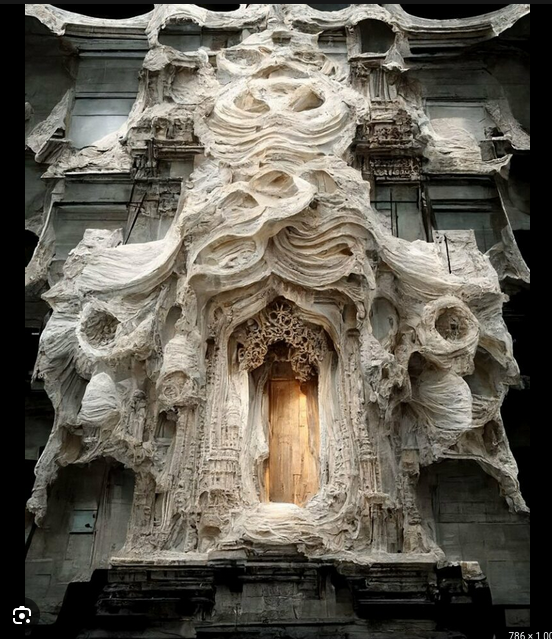
A very interesting and thought-provoking post. I liked all three of the rose poems, although the first AI poem is the most old-fashioned. I find the picture of the architectural facade interesting, but also disturbing, like a natural process gone awry (like cancer). I suppose each of us has aesthetic boundaries regarding what we consider acceptable or pleasing. Artists have always pushed those boundaries, of course.
LikeLiked by 1 person
Exactly, which is why I pointed out if a poetry evaluator is necessary in the second paragraph.
Art is highly subjective.
A true test of what is beautiful is put wonderfully by Oscar Wilde when he says, “ Beauty is the only thing that time cannot harm. Philosophies fall away like sand, creeds follow one another, but what is beautiful is a joy for all seasons, a possession for all eternity.“ I think a good work of art will stand the test of time. Only issue is however, a lot of good art is unknown to public.
To me, the architecture looked like the entrance door to the castle of an evil witch/wizard in fantasy lore. 🙂
Thank you very much for your input and keeping the discussion alive. Best wishes. 🌸
LikeLiked by 1 person
That’s a good quote by Oscar Wilde. I haven’t seen it before.
Yes, an evil witch or wizard must live there. Or maybe a vampire. 🧛♂️
LikeLiked by 1 person
As an Artist, writer and professional UX researcher, I can appreciate where you are coming from and have throughly enjoyed your expertise on the situation. I wish more people understood Ai as deeply as you do! Education is so important.
LikeLiked by 1 person
Hello. Thank you very much for your feedback. I’m enjoying your blog as well. I will delve further into it.
I’m not sure if I understand AI deeply, but I have worked on it a couple of years now to know what it is and what it is not. There are a lot of misconceptions coming from media and podcasts; therefore, I feel that it is better to interview scientists who are actually working on it instead of ex-scientists or CEOs.
LikeLiked by 1 person
An exceptionally well formatted write, Leah.
taking us through everything in stages made this more enjoyable to read and understand, for AI and all that comes with it can really be frustrating at times lol.
Thank you for this great share🤍
LikeLiked by 1 person
Thanks for your input. You are right when you say that it can get frustrating at times. AI is confusing to most people and some of the ex-scientists make very strong statements on interviews and podcasts which tend to scare people and shed a questionable light on regular 9-5 working AI researchers such as myself. Thank you for your interest and engagement . 🙂
LikeLiked by 1 person
I agree… if not understood on the current level, they tend to pass off fear to others.
my pleasure, Leah. 🤍
LikeLiked by 1 person
A “small” opinion rant…
First I haven’t pursued AI as much as I want so my awareness on it is still very superficial; but I believe that AI is a space that has first a lot of potential and is in dire need of more exploration and understanding; I would say that while we attempt to assimilate our learning methods to human processing, the same processing can be biased by the trainer, the model and the general space of development… I think humans still think on a more “general picture” way than being focused on the actual topic at hand.
Not that I thing one method is right and the other is wrong, is more that this change on the learning process creates gaps between what an AI model can objectively learn and what a human can learn on the general level.
I think this also bring me to the point that we can’t say anything final yet about AI in terms of creativity and others, as I would say it is actually still constrained by the learning methodologies we can impart to it; I think is a powerful tool to use still for as you say review and validation but I think what really makes us apart, and what I feel each creator should strive for (also talking from a rookie perspective), is that we have an ability to impart our own being into the things we create; that special touch that sets us apart from others that can only be created from personal experience.
Will AI one day be able to compete with us, yes yes I think it will be able to reach, is that day close… I don’t think is close by a mile yet…. some areas might be more further developed and beauty depends on the eye of the beholder… but I feel human creativity remains yet a particular piece of our selves.
I won’t get into points of will AI steal our jobs and all of that, because I feel is more of finding a balance sort of a thing; maybe in the future it will actually allow all of us to dedicate ourselves into creation more than any other thing which I think would be a cool space to land on hehe
LikeLiked by 1 person
I added a new segment as per what we discussed :). Thank you for your very valuable input.
LikeLike
I usually use AI for generating ideas, a friend of mine told me to get the AI to ask me questions and changes a bit of the dynamics of getting the information served and more in generating content
LikeLiked by 1 person
That’s a good point you have raised. Personally, I have never tried getting AI to ask me questions but will keep it in mind and see how the conversation pans out. Thank you for your input. 🙂
LikeLiked by 1 person
Brilliant and informative write. Thanks for sharing this with us.🙏
LikeLiked by 1 person
Thank you Didier. I’m glad I could make you feel that way. Best wishes. 🌸
LikeLike
AI will only evolve and grow in the coming years. It could very well replace humans, however it would be better for both, if AI is treated as a partner instead of a replacement for humans.
LikeLiked by 1 person
We are in trouble if we are not in check of what we expect from AI. To expect AI to replace humans is dangerous – and if taken too far, is depressing. So yes, I like the choice of your word ‘partner’ :). Best wishes.
LikeLiked by 1 person
Thank you for this balanced perspective on AI, Leah. This is a fascinating and emotive subject, and we are very much in need of wise heads, like yours, to stop us from losing our own.
LikeLiked by 1 person
Thank you Michael for your insightful and kind comment. There is a saying something along the sentiments of – humanity will manage to find a way to survive and I would like to believe that is the case. Only time will tell what the future unfolds. Best wishes.
LikeLiked by 1 person
Yes, hopefully it will work out fine 🙂
LikeLiked by 2 people
This is very interesting article. Provoking thoughts. I think I would have pretty many questions for you because you are a pro in this field. One question I can ask right now, thought this is pretty sure the one which is in uninteresting category for you but “For people, all of us doing things and working concretely is very important. I think AI is going to take away all of this from the people. Everywhere we have to use machines and the way we just passively stare at the screen. We are always just receivers. People have naturally need to give something, it makes them feel to be accepted, it gives meaning to our lives. I think the more things are automated the more anxious and frustrated people will be. Also this affects relationships between people in different levels etc” I think you’ll get my point. Would be interesting to hear your opinion… Anyway have a great weekend 🦋🌺😊
LikeLiked by 1 person
HI Jean, you have raised very interesting points. It is true that in spite of all the technologies comforts of today, there is a deep sense of loneliness, now more than ever. This is more so because a lot of people think technology is entertaining and advanced enough to sustain them, until they realize that they were wrong all along. However, in spite of all this, I have seen that people still have an innate need to connect with others, even though they feel ashamed to admit it. We are too shy to approach people thinking we are a bother. I’m hoping that AI itself is recommending people to go out and mingle. Take care. 🙂
LikeLiked by 1 person
This is an interesting answer. Especially “feeling ashamed”. Could it be possible that people have to receive so much that they themselves feel being bothered and therefore they think that they bother others if they approach them? Interesting if AI can support them to overcome their shyness 😊
LikeLike